
About Me
I am currently a Research Engineer at Generative Bionics, where I work on the design and development of physical AI models for locomanipulation.
Before joining Generative Bionics, I was a PostDoc in the PAVIS group at the Istituto Italiano di Tecnologia (IIT). The focus of my research activity was the design of computer vision models enabling robots to explore and interact with objects or people in the environment.
I obtained my PhD in Interactive and Cognitive Environments, a joint Doctorate between University of Genoa and Queen Mary University of London. The main topic of my PhD research was Affordance Segmentation that identifies the surfaces of potential interaction between an agent (e.g. a robotic hand) and an object relying only on visual information. The exciting and fascinating aspect of Affordance Segmentation is the connection to robotic and prosthetic applications, enabling assistive technologies (e.g., grasping, object manipulation) or collaborative human-robot scenarios.
Warning
Problem: The current name of your GitHub Pages repository ("Solution: Please consider renaming the repository to "
http://".
However, if the current repository name is intended, you can ignore this message by removing "{% include widgets/debug_repo_name.html %}" in index.html.
Action required
Problem: The current root path of this site is "baseurl ("_config.yml.
Solution: Please set the
baseurl in _config.yml to "Research interests
-
-
-
Embodied AI
-
Computer Vision
-
Machine Learning
-
Multimodal fusion
-
Affordance prediction
-
Reproducibility
Experience
-
Research EngineerGenerative BionicsJan. 2026 - Present
-
Postdoctoral ResearcherIstituto Italiano di TecnologiaJuly 2024 - Dec. 2025
Latest works
Memory-Augmented Vision-Language Agents for Persistent and Semantically Consistent Object Captioning
T. Galliena, S. Rosa, T. Apicella, P. Morerio, A. Del Bue, L. Natale
Winter Conference on Applications of Computer Vision (WACV), 2026
Abstract
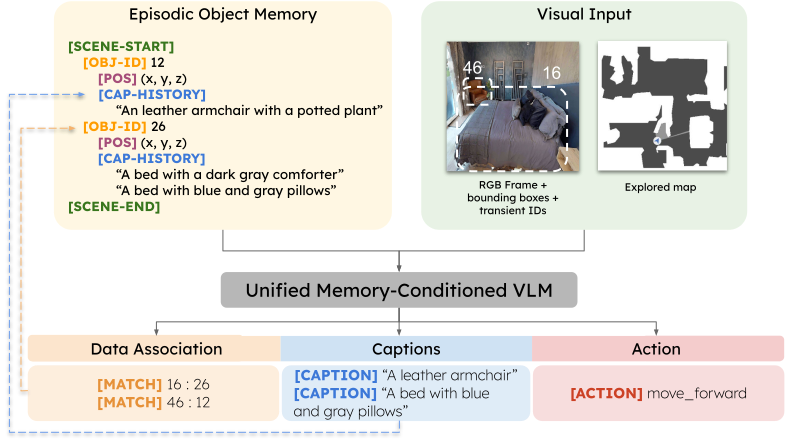
Vision-Language Models (VLMs) often yield inconsistent descriptions of the same object across viewpoints, hindering the ability of embodied agents to construct consistent semantic representations over time. Previous methods resolved inconsistencies using offline multi-view aggregation or multi-stage pipelines that decouple exploration, data association, and caption learning, with limited capacity to reason over previously observed objects. In this paper, we introduce a unified, memory-augmented Vision-Language agent that simultaneously handles data association, object captioning, and exploration policy within a single autoregressive framework. The model processes the current RGB observation, a top-down explored map, and an object-level episodic memory serialized into object-level tokens, ensuring persistent object identity and semantic consistency across extended sequences. To train the model in a self-supervised manner, we collect a dataset in photorealistic 3D environments using a disagreement-based policy and a pseudo-captioning model that enforces consistency across multi-view caption histories. Extensive evaluation on a manually annotated object-level test set, demonstrate improvements of up to +11.86% in standard captioning scores and +7.39% in caption self-similarity over baseline models, while enabling scalable performance through a compact scene representation. Code, model weights, and data are available at https://hsp-iit.github.io/epos-vlm/.
Memory-Augmented Vision-Language Agents for Persistent and Semantically Consistent Object Captioning
T. Galliena, S. Rosa, T. Apicella, P. Morerio, A. Del Bue, L. Natale
Winter Conference on Applications of Computer Vision (WACV), 2026
Abstract
Vision-Language Models (VLMs) often yield inconsistent descriptions of the same object across viewpoints, hindering the ability of embodied agents to construct consistent semantic representations over time. Previous methods resolved inconsistencies using offline multi-view aggregation or multi-stage pipelines that decouple exploration, data association, and caption learning, with limited capacity to reason over previously observed objects. In this paper, we introduce a unified, memory-augmented Vision-Language agent that simultaneously handles data association, object captioning, and exploration policy within a single autoregressive framework. The model processes the current RGB observation, a top-down explored map, and an object-level episodic memory serialized into object-level tokens, ensuring persistent object identity and semantic consistency across extended sequences. To train the model in a self-supervised manner, we collect a dataset in photorealistic 3D environments using a disagreement-based policy and a pseudo-captioning model that enforces consistency across multi-view caption histories. Extensive evaluation on a manually annotated object-level test set, demonstrate improvements of up to +11.86% in standard captioning scores and +7.39% in caption self-similarity over baseline models, while enabling scalable performance through a compact scene representation. Code, model weights, and data are available at https://hsp-iit.github.io/epos-vlm/.
HIDRA: Hierarchical Dual-Routing Attention for Replay-Free Lifelong Imitation Learning
F. Yu, M. Tiezzi, C. Beyan, T. Apicella, V. Murino
Conference on Neural Information Processing Systems (NeurIPS), 2026
Abstract
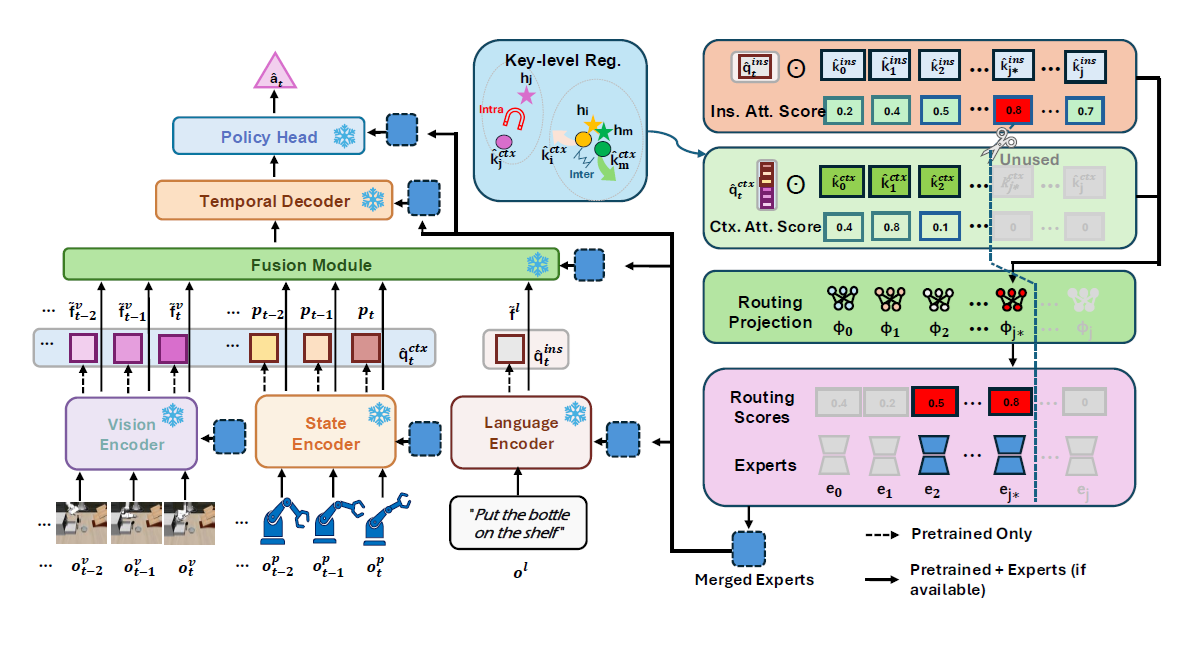
Robotic agents operating in real-world environments must adapt continuously from a stream of multimodal demonstrations, often under constraints that preclude storing or revisiting past data. In this replay-free, single-pass lifelong imitation learning setting, sequential updates can progressively distort the representation space, making expert-based approaches particularly sensitive to routing interference, causing expert selection to degrade over time. We propose HIDRA, a structured routing framework that mitigates this issue through a hierarchical dual-attention mechanism, which decouples instruction-level expert retrieval from context-dependent refinement. To further stabilize routing under representation drift, HIDRA introduces a key-level geometric regularization that enforces both alignment within tasks and separation across tasks. The resulting approach enables reliable expert selection while supporting an expandable set of experts for continual adaptation. We evaluate HIDRA on several LIBERO benchmark suites, including more challenging variants with heterogeneous task sequences and paraphrased language instructions. Our approach consistently outperforms both replay-free and replay-based baselines, improving AUC and forward transfer while maintaining low forgetting, with stronger gains under high interference and language variation. Code will be released.
HIDRA: Hierarchical Dual-Routing Attention for Replay-Free Lifelong Imitation Learning
F. Yu, M. Tiezzi, C. Beyan, T. Apicella, V. Murino
Conference on Neural Information Processing Systems (NeurIPS), 2026
Abstract
Robotic agents operating in real-world environments must adapt continuously from a stream of multimodal demonstrations, often under constraints that preclude storing or revisiting past data. In this replay-free, single-pass lifelong imitation learning setting, sequential updates can progressively distort the representation space, making expert-based approaches particularly sensitive to routing interference, causing expert selection to degrade over time. We propose HIDRA, a structured routing framework that mitigates this issue through a hierarchical dual-attention mechanism, which decouples instruction-level expert retrieval from context-dependent refinement. To further stabilize routing under representation drift, HIDRA introduces a key-level geometric regularization that enforces both alignment within tasks and separation across tasks. The resulting approach enables reliable expert selection while supporting an expandable set of experts for continual adaptation. We evaluate HIDRA on several LIBERO benchmark suites, including more challenging variants with heterogeneous task sequences and paraphrased language instructions. Our approach consistently outperforms both replay-free and replay-based baselines, improving AUC and forward transfer while maintaining low forgetting, with stronger gains under high interference and language variation. Code will be released.
Reproducible Multimodal Affordance Prediction
T. Apicella, A. Xompero, A. Cavallaro
European Conference on Computer Vision Workshops (ECCVW), 2026
Abstract
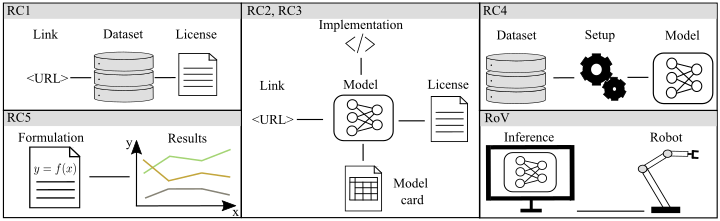
Affordance prediction is the identification of potential actions an agent can perform on a target object from multimodal inputs. Affordance prediction methods are difficult to evaluate and compare due to heterogeneous problem formulations, inconsistent dataset annotations, incomplete reporting of experimental protocols, and limited information about deployment conditions. These limitations challenge fair benchmarking and performance comparison. To promote transparency, we propose the Affordance Sheet, a documentation detailing task formulation with its input modalities, model architectures and training information, datasets, and experimental protocols. Affordance Sheets enable reproducible benchmarking and reliable evaluation of affordance models for real-world scenarios, including generalisation to novel conditions and human safety.
Reproducible Multimodal Affordance Prediction
T. Apicella, A. Xompero, A. Cavallaro
European Conference on Computer Vision Workshops (ECCVW), 2026
Abstract
Affordance prediction is the identification of potential actions an agent can perform on a target object from multimodal inputs. Affordance prediction methods are difficult to evaluate and compare due to heterogeneous problem formulations, inconsistent dataset annotations, incomplete reporting of experimental protocols, and limited information about deployment conditions. These limitations challenge fair benchmarking and performance comparison. To promote transparency, we propose the Affordance Sheet, a documentation detailing task formulation with its input modalities, model architectures and training information, datasets, and experimental protocols. Affordance Sheets enable reproducible benchmarking and reliable evaluation of affordance models for real-world scenarios, including generalisation to novel conditions and human safety.