2026
Memory-Augmented Vision-Language Agents for Persistent and Semantically Consistent Object Captioning
T. Galliena, S. Rosa, T. Apicella, P. Morerio, A. Del Bue, L. Natale
Preprint, 2026
Abstract
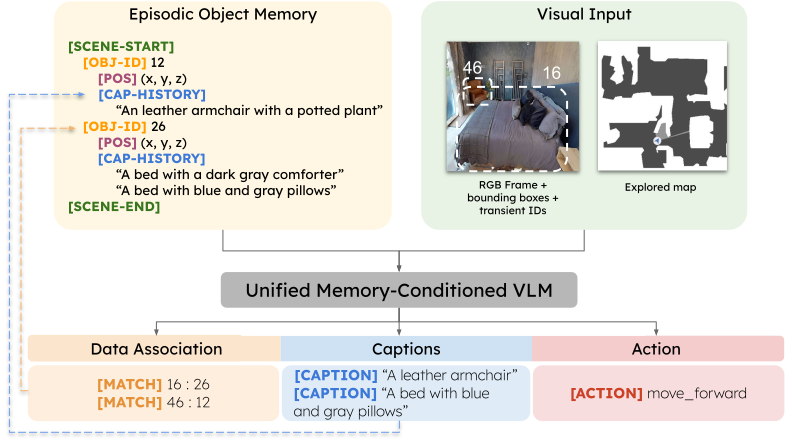
Vision-Language Models (VLMs) often yield inconsistent descriptions of the same object across viewpoints, hindering the ability of embodied agents to construct consistent semantic representations over time. Previous methods resolved inconsistencies using offline multi-view aggregation or multi-stage pipelines that decouple exploration, data association, and caption learning, with limited capacity to reason over previously observed objects. In this paper, we introduce a unified, memory-augmented Vision-Language agent that simultaneously handles data association, object captioning, and exploration policy within a single autoregressive framework. The model processes the current RGB observation, a top-down explored map, and an object-level episodic memory serialized into object-level tokens, ensuring persistent object identity and semantic consistency across extended sequences. To train the model in a self-supervised manner, we collect a dataset in photorealistic 3D environments using a disagreement-based policy and a pseudo-captioning model that enforces consistency across multi-view caption histories. Extensive evaluation on a manually annotated object-level test set, demonstrate improvements of up to +11.86% in standard captioning scores and +7.39% in caption self-similarity over baseline models, while enabling scalable performance through a compact scene representation. Code, model weights, and data are available at https://hsp-iit.github.io/epos-vlm/.
Memory-Augmented Vision-Language Agents for Persistent and Semantically Consistent Object Captioning
T. Galliena, S. Rosa, T. Apicella, P. Morerio, A. Del Bue, L. Natale
Preprint, 2026
Abstract
Vision-Language Models (VLMs) often yield inconsistent descriptions of the same object across viewpoints, hindering the ability of embodied agents to construct consistent semantic representations over time. Previous methods resolved inconsistencies using offline multi-view aggregation or multi-stage pipelines that decouple exploration, data association, and caption learning, with limited capacity to reason over previously observed objects. In this paper, we introduce a unified, memory-augmented Vision-Language agent that simultaneously handles data association, object captioning, and exploration policy within a single autoregressive framework. The model processes the current RGB observation, a top-down explored map, and an object-level episodic memory serialized into object-level tokens, ensuring persistent object identity and semantic consistency across extended sequences. To train the model in a self-supervised manner, we collect a dataset in photorealistic 3D environments using a disagreement-based policy and a pseudo-captioning model that enforces consistency across multi-view caption histories. Extensive evaluation on a manually annotated object-level test set, demonstrate improvements of up to +11.86% in standard captioning scores and +7.39% in caption self-similarity over baseline models, while enabling scalable performance through a compact scene representation. Code, model weights, and data are available at https://hsp-iit.github.io/epos-vlm/.
Reproducible Multimodal Affordance Prediction
T. Apicella, A. Xompero, A. Cavallaro
European Conference on Computer Vision Workshops (ECCVW), 2026
Abstract
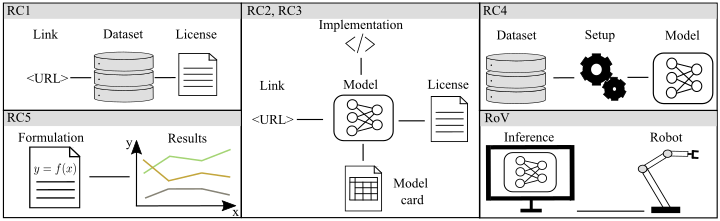
Affordance prediction is the identification of potential actions an agent can perform on a target object from multimodal inputs. Affordance prediction methods are difficult to evaluate and compare due to heterogeneous problem formulations, inconsistent dataset annotations, incomplete reporting of experimental protocols, and limited information about deployment conditions. These limitations challenge fair benchmarking and performance comparison. To promote transparency, we propose the Affordance Sheet, a documentation detailing task formulation with its input modalities, model architectures and training information, datasets, and experimental protocols. Affordance Sheets enable reproducible benchmarking and reliable evaluation of affordance models for real-world scenarios, including generalisation to novel conditions and human safety.
Reproducible Multimodal Affordance Prediction
T. Apicella, A. Xompero, A. Cavallaro
European Conference on Computer Vision Workshops (ECCVW), 2026
Abstract
Affordance prediction is the identification of potential actions an agent can perform on a target object from multimodal inputs. Affordance prediction methods are difficult to evaluate and compare due to heterogeneous problem formulations, inconsistent dataset annotations, incomplete reporting of experimental protocols, and limited information about deployment conditions. These limitations challenge fair benchmarking and performance comparison. To promote transparency, we propose the Affordance Sheet, a documentation detailing task formulation with its input modalities, model architectures and training information, datasets, and experimental protocols. Affordance Sheets enable reproducible benchmarking and reliable evaluation of affordance models for real-world scenarios, including generalisation to novel conditions and human safety.
Lifelong Imitation Learning with Multimodal Latent Replay and Incremental Adjustment
F. Yu, M. Tiezzi, T. Apicella, C. Beyan, V. Murino
Conference on Computer Vision and Pattern Recognition (CVPR), 2026
Abstract
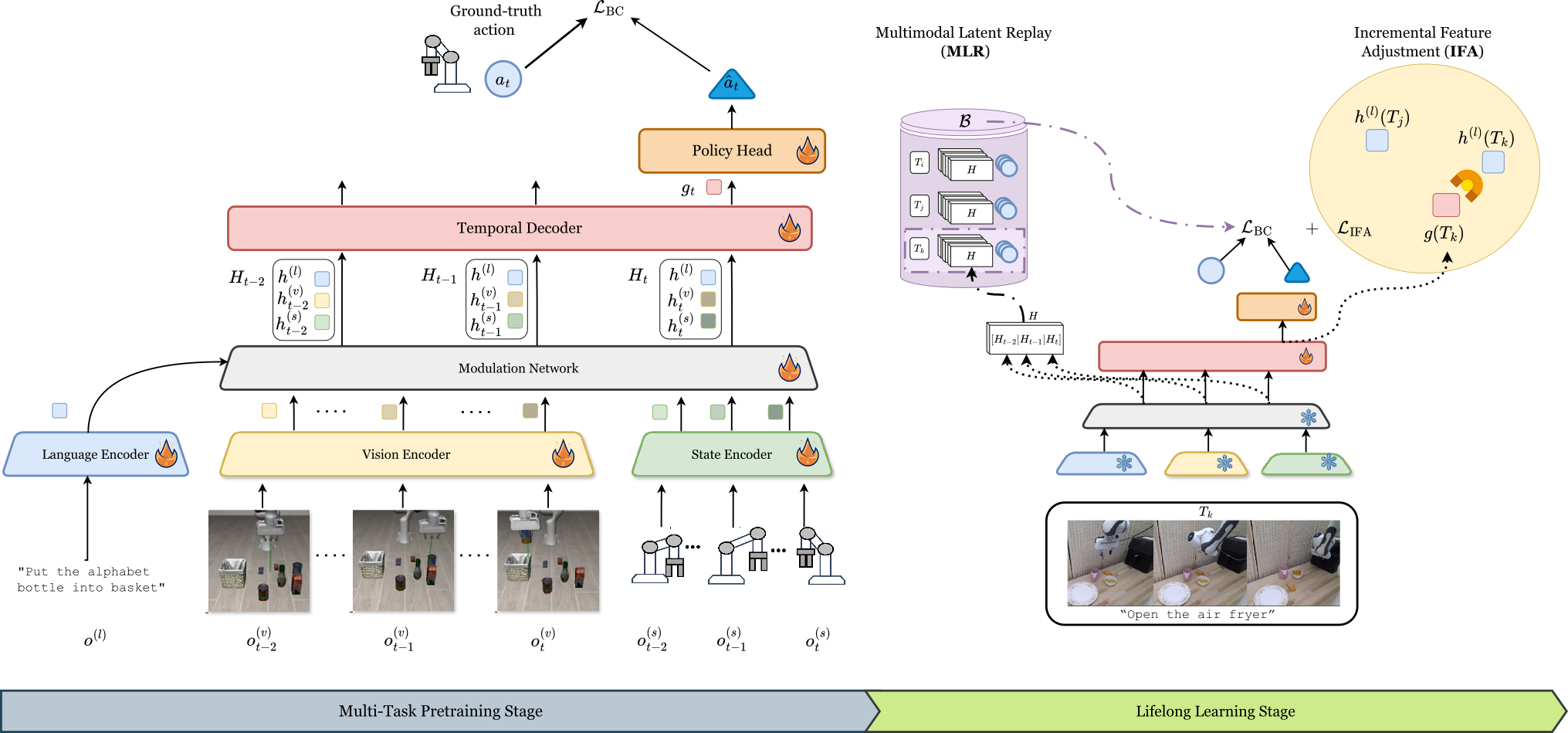
We introduce a lifelong imitation learning framework that enables continual policy refinement across sequential tasks under realistic memory and data constraints. Our approach departs from conventional experience replay by operating entirely in a multimodal latent space, where compact representations of visual, linguistic, and robot's state information are stored and reused to support future learning. To further stabilize adaptation, we introduce an incremental feature adjustment mechanism that regularizes the evolution of task embeddings through an angular margin constraint, preserving inter-task distinctiveness. Our method establishes a new state of the art in the LIBERO benchmarks, achieving 10-17 point gains in AUC and up to 65% less forgetting compared to previous leading methods. Ablation studies confirm the effectiveness of each component, showing consistent gains over alternative strategies. The code is available at: https://github.com/yfqi/lifelong_mlr_ifa
Lifelong Imitation Learning with Multimodal Latent Replay and Incremental Adjustment
F. Yu, M. Tiezzi, T. Apicella, C. Beyan, V. Murino
Conference on Computer Vision and Pattern Recognition (CVPR), 2026
Abstract
We introduce a lifelong imitation learning framework that enables continual policy refinement across sequential tasks under realistic memory and data constraints. Our approach departs from conventional experience replay by operating entirely in a multimodal latent space, where compact representations of visual, linguistic, and robot's state information are stored and reused to support future learning. To further stabilize adaptation, we introduce an incremental feature adjustment mechanism that regularizes the evolution of task embeddings through an angular margin constraint, preserving inter-task distinctiveness. Our method establishes a new state of the art in the LIBERO benchmarks, achieving 10-17 point gains in AUC and up to 65% less forgetting compared to previous leading methods. Ablation studies confirm the effectiveness of each component, showing consistent gains over alternative strategies. The code is available at: https://github.com/yfqi/lifelong_mlr_ifa
2025
Embodied Image Captioning: Self-supervised Learning Agents for Spatially Coherent Image Descriptions
T. Galliena, T. Apicella, S. Rosa, P. Morerio, A. Del Bue, L. Natale
International Conference on Computer Vision (ICCV), 2025
Abstract
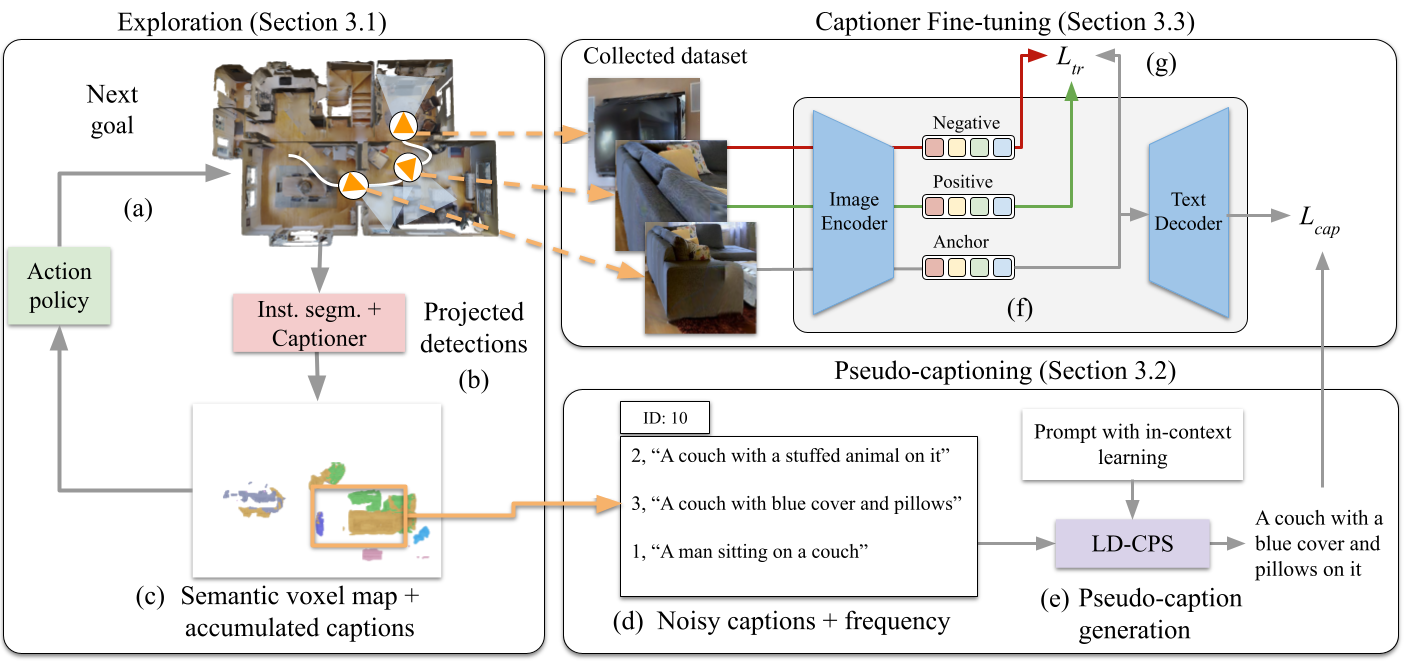
We present a self-supervised method to improve an agent's abilities in describing arbitrary objects while actively exploring a generic environment. This is a challenging problem, as current models struggle to obtain coherent image captions due to different camera viewpoints and clutter. We propose a three-phase framework to fine-tune existing captioning models that enhances caption accuracy and consistency across views via a consensus mechanism. First, an agent explores the environment, collecting noisy imagecaption pairs. Then, a consistent pseudo-caption for each object instance is distilled via consensus using a large language model. Finally, these pseudo-captions are used to fine-tune an off-the-shelf captioning model, with the addition of contrastive learning. We analyse the performance of the combination of captioning models, exploration policies, pseudo-labeling methods, and fine-tuning strategies, on our manually labeled test set. Results show that a policy can be trained to mine samples with higher disagreement compared to classical baselines. Our pseudo-captioning method, in combination with all policies, has a higher semantic similarity compared to other existing methods, and fine-tuning improves caption accuracy and consistency by a significant margin. Code and test set annotations available at https://hsp-iit.github.io/embodiedcaptioning/
Embodied Image Captioning: Self-supervised Learning Agents for Spatially Coherent Image Descriptions
T. Galliena, T. Apicella, S. Rosa, P. Morerio, A. Del Bue, L. Natale
International Conference on Computer Vision (ICCV), 2025
Abstract
We present a self-supervised method to improve an agent's abilities in describing arbitrary objects while actively exploring a generic environment. This is a challenging problem, as current models struggle to obtain coherent image captions due to different camera viewpoints and clutter. We propose a three-phase framework to fine-tune existing captioning models that enhances caption accuracy and consistency across views via a consensus mechanism. First, an agent explores the environment, collecting noisy imagecaption pairs. Then, a consistent pseudo-caption for each object instance is distilled via consensus using a large language model. Finally, these pseudo-captions are used to fine-tune an off-the-shelf captioning model, with the addition of contrastive learning. We analyse the performance of the combination of captioning models, exploration policies, pseudo-labeling methods, and fine-tuning strategies, on our manually labeled test set. Results show that a policy can be trained to mine samples with higher disagreement compared to classical baselines. Our pseudo-captioning method, in combination with all policies, has a higher semantic similarity compared to other existing methods, and fine-tuning improves caption accuracy and consistency by a significant margin. Code and test set annotations available at https://hsp-iit.github.io/embodiedcaptioning/
2024
Segmenting Object Affordances: Reproducibility and Sensitivity to Scale
T. Apicella, A. Xompero, P. Gastaldo, A. Cavallaro
European Conference on Computer Vision Workshops (ECCVW), 2024
Abstract
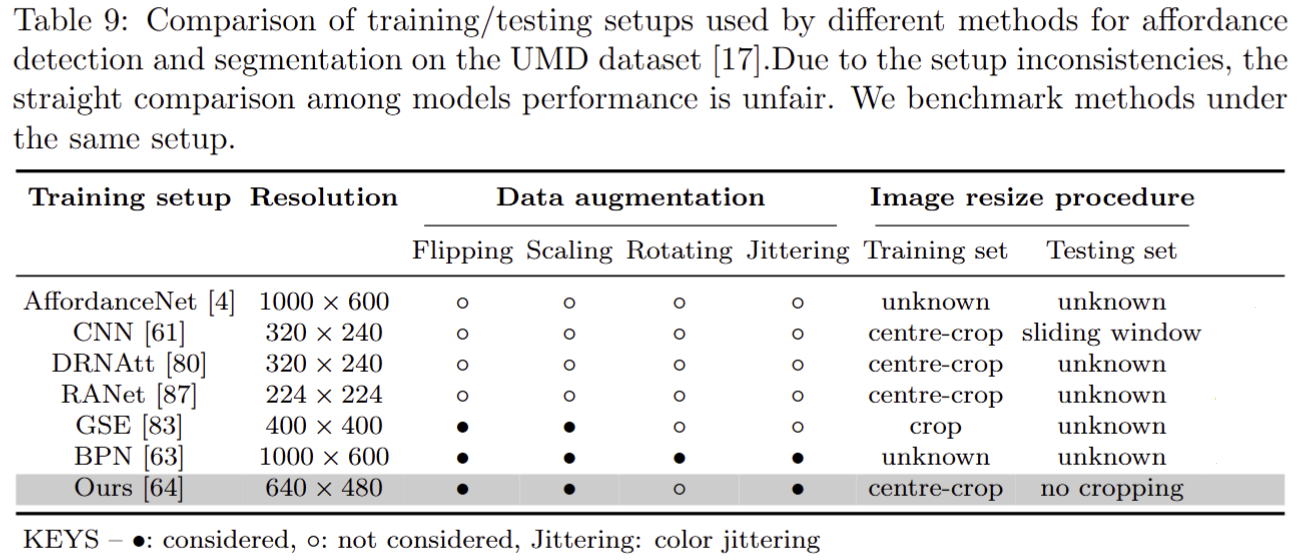
Visual affordance segmentation identifies image regions of an object an agent can interact with. Existing methods re-use and adapt learning-based architectures for semantic segmentation to the affordance segmentation task and evaluate on small-size datasets. However, experimental setups are often not reproducible, thus leading to unfair and inconsistent comparisons. In this work, we benchmark these methods under a reproducible setup on two single objects scenarios, tabletop without occlusions and hand-held containers, to facilitate future comparisons. We include a version of a recent architecture, Mask2Former, re-trained for affordance segmentation and show that this model is the best-performing on most testing sets of both scenarios. Our analysis shows that models are not robust to scale variations when object resolutions differ from those in the training set.
Segmenting Object Affordances: Reproducibility and Sensitivity to Scale
T. Apicella, A. Xompero, P. Gastaldo, A. Cavallaro
European Conference on Computer Vision Workshops (ECCVW), 2024
Abstract
Visual affordance segmentation identifies image regions of an object an agent can interact with. Existing methods re-use and adapt learning-based architectures for semantic segmentation to the affordance segmentation task and evaluate on small-size datasets. However, experimental setups are often not reproducible, thus leading to unfair and inconsistent comparisons. In this work, we benchmark these methods under a reproducible setup on two single objects scenarios, tabletop without occlusions and hand-held containers, to facilitate future comparisons. We include a version of a recent architecture, Mask2Former, re-trained for affordance segmentation and show that this model is the best-performing on most testing sets of both scenarios. Our analysis shows that models are not robust to scale variations when object resolutions differ from those in the training set.
2023
Affordance segmentation of hand-occluded containers from exocentric images
T. Apicella, A. Xompero, E. Ragusa, R. Berta, A. Cavallaro, P. Gastaldo
International Conference on Computer Vision Workshops (ICCVW), 2023
Abstract
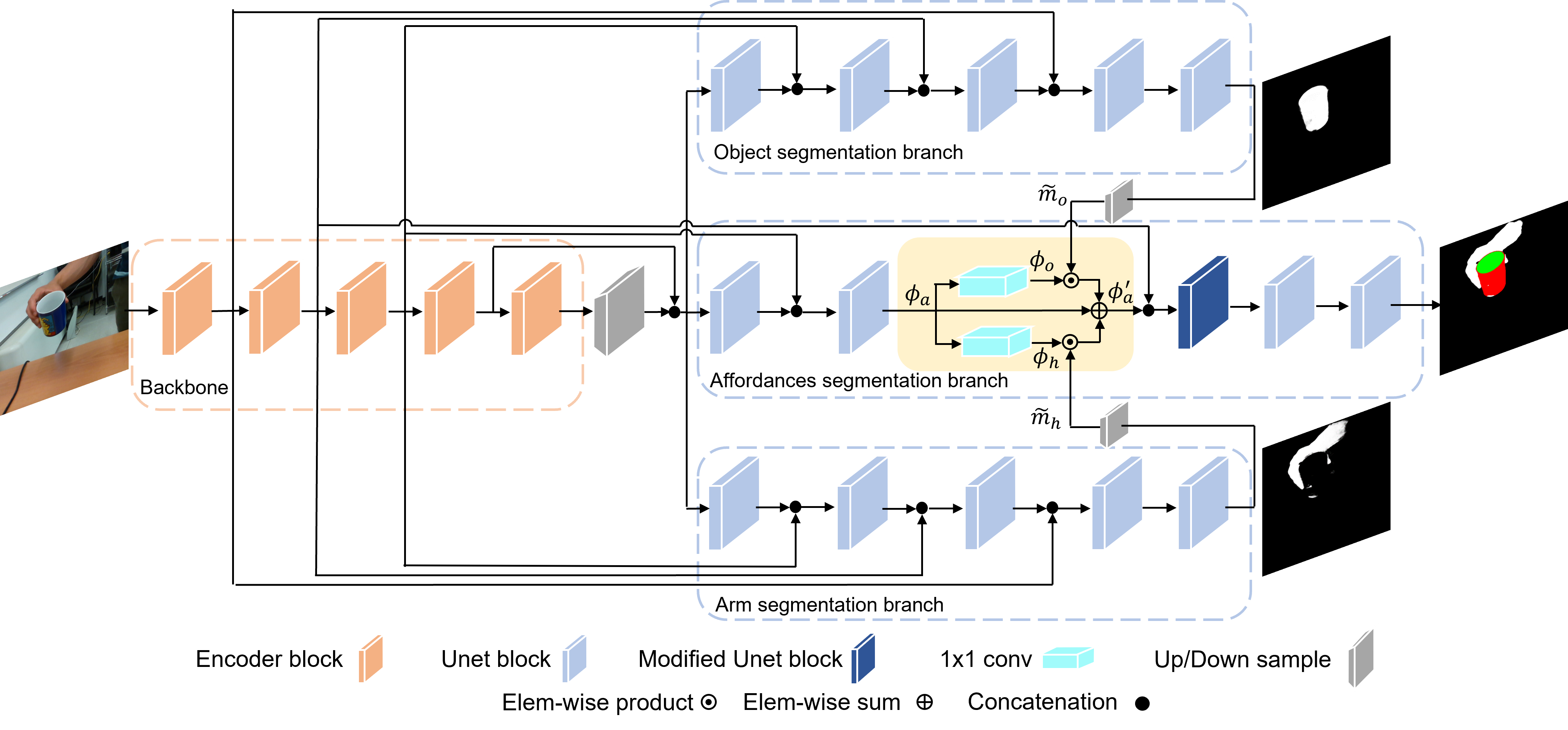
Visual affordance segmentation identifies the surfaces of potential interaction with an object in an image. The variety of the geometry and physical properties of objects as well as occlusions are common challenges for the identification of affordances. Occlusions of objects that are hand-held by a person is a particular challenge when people are manipulating an object. To address this challenge, we propose an affordance segmentation model that uses auxiliary branches to focus on the object and hand regions separately. The proposed model learns affordance features under hand-occlusion by weighting the feature map through hand and object segmentation. To train the proposed model, we annotated the visual affordances of an existing dataset with mixed-reality images of hand-held containers in third-person (exocentric) images. Experiments on both real and mixed-reality show that our model achieves better affordance segmentation and generalisation than existing models.
[arXiv] [website] [code] [trained model] [mixed-reality data]
Affordance segmentation of hand-occluded containers from exocentric images
T. Apicella, A. Xompero, E. Ragusa, R. Berta, A. Cavallaro, P. Gastaldo
International Conference on Computer Vision Workshops (ICCVW), 2023
Abstract
Visual affordance segmentation identifies the surfaces of potential interaction with an object in an image. The variety of the geometry and physical properties of objects as well as occlusions are common challenges for the identification of affordances. Occlusions of objects that are hand-held by a person is a particular challenge when people are manipulating an object. To address this challenge, we propose an affordance segmentation model that uses auxiliary branches to focus on the object and hand regions separately. The proposed model learns affordance features under hand-occlusion by weighting the feature map through hand and object segmentation. To train the proposed model, we annotated the visual affordances of an existing dataset with mixed-reality images of hand-held containers in third-person (exocentric) images. Experiments on both real and mixed-reality show that our model achieves better affordance segmentation and generalisation than existing models.
[arXiv] [website] [code] [trained model] [mixed-reality data]
2022
Container Localisation and Mass Estimation with an RGB-D Camera
T. Apicella, G. Slavic, E. Ragusa, P. Gastaldo, L. Marcenaro
International Conference on Acoustics, Speech, and Signal Processing (ICASSP), 2022
Abstract
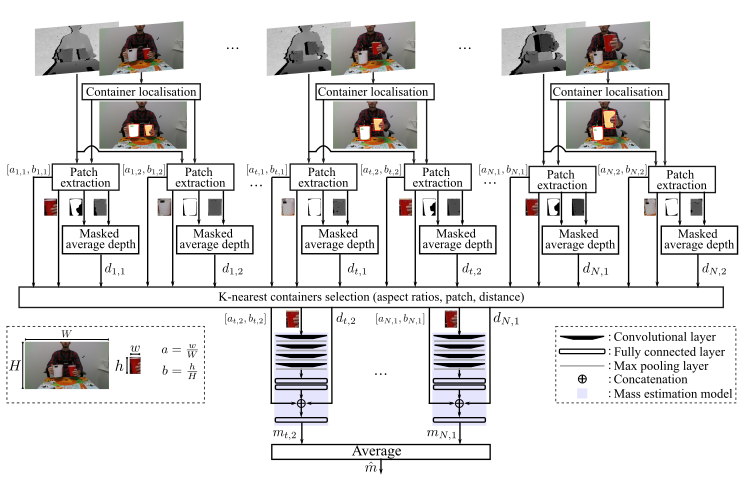
In the research area of human-robot interactions, the automatic estimation of the mass of a container manipulated by a person leveraging only visual information is a challenging task. The main challenges consist of occlusions, different filling materials and lighting conditions. The mass of an object constitutes key information for the robot to correctly regulate the force required to grasp the container. We propose a single RGB-D camera-based method to locate a manipulated container and estimate its empty mass i.e., independently of the presence of the content. The method first automatically selects a number of candidate containers based on the distance with the fixed frontal view, then averages the mass predictions of a lightweight model to provide the final estimation. Results on the CORSMAL Containers Manipulation dataset show that the proposed method estimates empty container mass obtaining a score of 71.08% under different lighting or filling conditions.
Container Localisation and Mass Estimation with an RGB-D Camera
T. Apicella, G. Slavic, E. Ragusa, P. Gastaldo, L. Marcenaro
International Conference on Acoustics, Speech, and Signal Processing (ICASSP), 2022
Abstract
In the research area of human-robot interactions, the automatic estimation of the mass of a container manipulated by a person leveraging only visual information is a challenging task. The main challenges consist of occlusions, different filling materials and lighting conditions. The mass of an object constitutes key information for the robot to correctly regulate the force required to grasp the container. We propose a single RGB-D camera-based method to locate a manipulated container and estimate its empty mass i.e., independently of the presence of the content. The method first automatically selects a number of candidate containers based on the distance with the fixed frontal view, then averages the mass predictions of a lightweight model to provide the final estimation. Results on the CORSMAL Containers Manipulation dataset show that the proposed method estimates empty container mass obtaining a score of 71.08% under different lighting or filling conditions.